Background of Our Electrical Enclosure lock Case Study
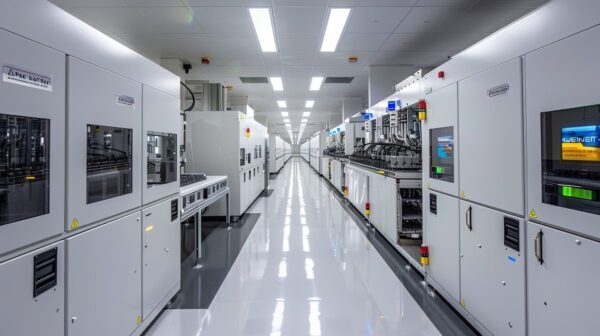
One of our long-standing customers, who is also one of the largest manufacturers of electrical enclosures, approached us with a request to update the locking system for one of their projects.
Until now, the enclosure in question had been secured with our B826 lock. Due to the height of the enclosure, which in some models reached 150 cm, it was necessary to install several locks in a single enclosure. The customer wanted the operator to avoid opening multiple locks one by one. Instead, they were looking for a solution that would allow a single lock to drive a multi-point locking system inside the enclosure.
Due to the minimal space inside the enclosure and the unusual materials used in its construction, none of the available solutions on the market could be applied. Redesigning the enclosure was also not an option due to the high investment costs.
Opportunity
We were therefore given the task: to design a multi-point locking system adapted to the limited space and unique materials used by the customer. An additional requirement was to incorporate a swing handle with a shaped key operated quarter turn lock. To support the project, both companies engaged not only their sales and procurement departments but also their NPD (New Product Development) teams.
Solution
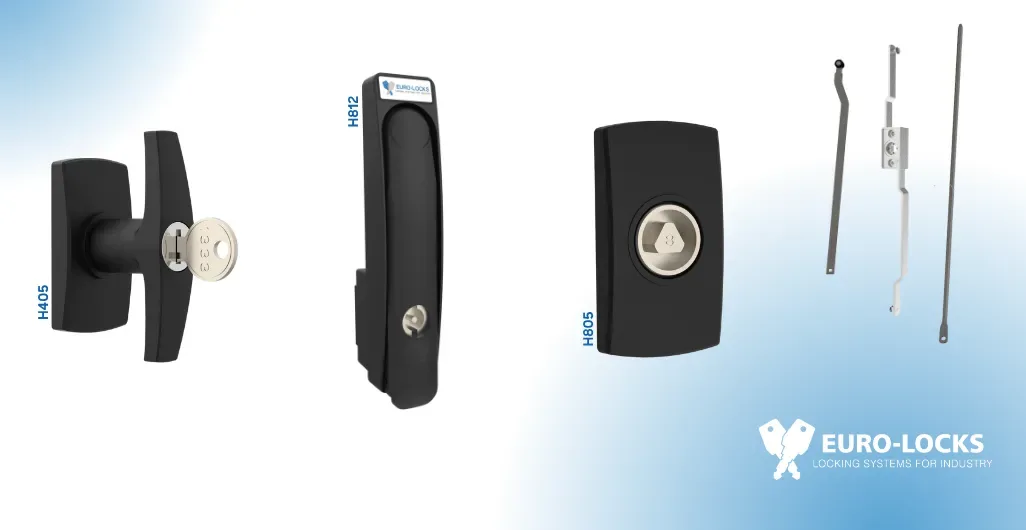
The customer provided us with a 3D model of the enclosure, and our NPD team began the design process. We proposed our H812 handle and designed a compatible modified W101 rod control mechanism, PR36 round rods, and specially developed rod guides. In addition, we made use of existing enclosure elements to provide support points for the locking system. We updated the customer’s 3D model with our components and sent it back, while also producing a prototype kit for installation and feedback.
The customer’s NPD team was not entirely satisfied with the solution. They pointed out the imprecise rod movement and the bulky handle, which did not match the cabinet’s design. We decided to visit the customer to examine the prototype in person and gain a better understanding of their requirements. During the meeting, we also discussed additional aspects that had not been raised earlier and reviewed possible alternatives. This approach allowed us to understand the customer’s vision and present our capabilities clearly.
We then restarted the design process. This time, we focused on our minimalist H805 escutcheon combined with modified PR1 flat rods. The main challenge was designing the mechanism driving the rods, but our engineering team found a suitable solution. Additionally, we proposed an optional version with a T-handle and H406 with key locking function for installations requiring a higher security level, as well as a dedicated, proprietary key code for the customer.
The procedure followed the same steps as in the first stage: updating the 3D enclosure models with the proposed solution, preparing the quotation, producing prototypes, customer installation, acceptance, and finally… the first implementation.
It is worth emphasising that for our company, which offers the highest standards of customer service, the first implementation is only the beginning of a long-term, mutually beneficial cooperation.
Outcome
- Ergonomic operation – one lock controls the entire locking system.
- Space-saving design – compact solution adapted to the enclosure’s unique materials.
- Aesthetics – design aligned with the customer’s vision.
- Security – option of an individually assigned proprietary key code.
Business Benefits
- An innovative locking system was implemented without modifying the enclosure design.
- The customer received a tailor-made solution that increased the functionality and appeal of their products.
- The first implementation opened the door to further long-term cooperation.
Why Euro-Locks?
- Flexibility & creativity – adapting the design to limited space and unusual materials.
- Partnership approach – close cooperation between both companies’ NPD departments.
- Innovation – unique technical solutions not available elsewhere on the market.