
Selecting the right wireless technology for your locking systems
Near Field Communication (NFC) and Radio Frequency Identification (RFID) technologies have significantly transformed modern access control and asset security locking systems, providing innovative and reliable solutions to address today’s complex security challenges.
Given their shared trait of wireless communication for data exchange, these two technologies are often confused to be one and the same. However, a deeper look into NFC and RFID does reveal key distinctions in functionality, practical applications and overall benefits.
For facility and security managers, understanding these differences is critical to making informed decisions and selecting the most effective locking solution tailored to specific operational requirements.
Not only can selecting the right option improve overall security, leveraging the right technology in your locking systems also offers enhanced efficiency and streamlined security processes for your chosen applications.
NFC and RFID Explained
RFID Technology
RFID (Radio Frequency Identification) leverages electromagnetic fields to identify and track tags attached to various objects with precision and efficiency. Using either passive or active tags, RFID technology has become a mainstay in smart locking systems, often utilised in commercial offices and workplaces, locker spaces and other access control areas thanks to its enhanced convenience. Also, an RFID fob or card is much more difficult to duplicate than a traditional key, ensuring heightened levels of security.
NFC Technology
NFC (Near Field Communication) is technically a specialised subset of RFID technology, designed for secure, short-range communication, typically within just a few centimeters. This innovative technology enables seamless two-way interactions, making it ideal for applications such as contactless payments, device pairing and access control. A key advantage of NFC is its ability to operate without an internal power source, as devices can draw energy directly from a nearby reader or receiver.
Key Differences Between NFC and RFID for Locks
Power Source
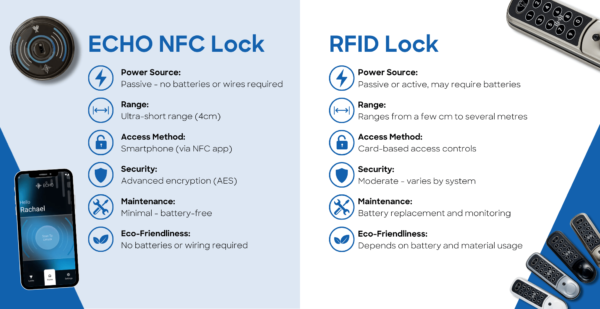
- RFID: Can be passive (no internal power, energy harvested from the reader) or active (battery-powered for longer ranges).
- NFC: Primarily passive, NFC harvests the tiny amount of energy it needs directly from the device communicating with it (such as a smartphone).
Range
- RFID: Can operate over varying distances, ranging from a few centimetres to several metres, depending on the system configuration (low-frequency or high-frequency).
- NFC: Operates exclusively within a very short range (usually 4cm or less), ensuring secure, targeted communication.
Data Transfer and Security
- RFID: Primarily uses one-way data transfer for basic identification and tracking tasks. It generally lacks advanced encryption unless specifically implemented.
- NFC: Designed for secure, two-way communication. It integrates Advanced Encryption Standards (AES), ensuring a higher level of security, such as is used in government systems and mobile payments.
Applications
- RFID: Best suited for broad scale identification and tracking, such as in logistics, asset management and contactless ticketing.
- NFC: Perfect for secure access control and personalised interactions, like unlocking locks with a smartphone or pairing devices.
ECHO Lock – NFC Powered Security by Lowe & Fletcher
ECHO lock by Lowe & Fletcher is a battery-free, NFC powered locking solution, designed specifically for streamlined, eco-friendly and secure access management.
How Does ECHO Work?
ECHO locks are powered by an NFC-enabled smartphone. A small amount of energy is harvested from your phone to operate the lock. Using the ECHO app, users can lock or unlock the system with just a tap, eliminating the need for keys, cards or even battery maintenance.
Why Choose ECHO for Your Locking System?
ECHO delivers several benefits that make it a standout choice for facilities managers looking for innovative solutions in locker systems:
- Battery-Free Operation: Reduces e-waste and lowers maintenance costs by removing the need for batteries or electrical wiring.
- Enhanced Security with AES Encryption: Uses the same encryption standard trusted by governments for top level security. Once the token is used to unlock the lock, it is deactivated, ensuring one-time tamper proof access.
- Eco-Friendly: With no batteries required, ECHO dramatically reduces the environmental and operational footprint of locker systems.
- User-Friendly Experience: All functionality is managed via the ECHO app and your NFC-enabled smartphone. Forget about storing keys, codes or RFID cards, everything you need is in your pocket.
How Does ECHO Compare to RFID Locks?
When comparing ECHO NFC locks with traditional RFID-enabled locks, the differences offer distinct advantages for specific use cases.
Over 130 Years of Locking Innovation
At Lowe & Fletcher, we’ve been shaping the landscape of the locking industry since 1889, manufacturing over 80 million locks annually across Europe and the UK, with unrivalled expertise.
Our extensive product range covers secure locking systems to meet all application requirements. Including:
ECHO, our latest locking innovation, is a first of its kind eco-friendly locking system that provides the optimal combination of security, efficiency and versatility, designed to simplify and revolutionise access management.
If you want to learn more about any Lowe & Fletcher locking solution, contact our team directly to discuss your requirements.